ACDT #103 meeting summary
The ACDT #103 meeting summary went up on Magicians at 00:03 on 2026-11-17 (an auto-generated Zoom summary, with a few names and EIP numbers transcribed wrong), along with the recording. Key points:
Ethereum Research Daily
ACDT #103 heard the audit results on the Glamsterdam repricing. ChainSecurity and the EF's internal search found about 200 issues between them, most of them easy to mitigate, but the call didn't decide whether to pull EIP-8037 from Amsterdam and left that to ACDE on 11-19. Vitalik came out in support of EIP-8037 and listed protocol features he expects to change, including a stateful ecrecover and possibly EIP-8141 as the only transaction type. He also says he's now a "total bull" on the leanPCS route for EIP-8288, which is on the agenda for tonight's Frame Transaction Breakout #8 at 21:00.
The ACDT #103 meeting summary went up on Magicians at 00:03 on 2026-11-17 (an auto-generated Zoom summary, with a few names and EIP numbers transcribed wrong), along with the recording. Key points:
The ACDT #103 meeting summary went up on Magicians at 00:03 on 2026-11-17 (an auto-generated Zoom summary, with a few names and EIP numbers transcribed wrong), along with the recording. Key points:
At 11:56 on 2026-11-16, with a Fileverse document. From the screenshots in the post:
Vitalik: my views on EIP-8037 at 11:56 on 2026-11-16, with a Fileverse document. From the screenshots in the post:
At 13:15 on 2026-11-16: airdrops are already advised to use Merkle trees (the issuer posts the root and each user pays to claim), and longer term token balances should live in UTXOs and, for privacy, keyed nonces. In another reply at 13:18 he says apps will retool toward more computation and less state in the medium run, and execution-heavy apps such as privacy protocols will get bolder about using more.
Vitalik replying on airdrops and state costs at 13:15 on 2026-11-16: airdrops are already advised to use Merkle trees (the issuer posts the root and each user pays to claim), and longer term token balances should live in UTXOs and, for privacy, keyed nonces. In another reply at 13:18 he says apps will retool toward more computation and less state in the medium run, and execution-heavy apps such as privacy protocols will get bolder about using more.
At 15:09 on 2026-11-16: state is growing more slowly than EIP-8037 first assumed, but at a 200M gas limit without the relevant EIPs it would still add about 255 GiB a year. Post-quantum and privacy transactions need more gas, so not raising the gas limit effectively cuts throughput.
At 17:31 on 2026-11-16 (plus an X post at 17:34): don't confuse consensus compatibility with application compatibility. Some of the eight assumptions in glamsterdam-gas-invariants concern execution semantics such as refunds, nested calls, reverts and gasleft(), which can affect control flow and security, and they weren't treated as first-class invariants in the spec and validation process early enough.
Pcaversaccio's long comment on the ACDT #103 issue at 17:31 on 2026-11-16 (plus an X post at 17:34): don't confuse consensus compatibility with application compatibility. Some of the eight assumptions in glamsterdam-gas-invariants concern execution semantics such as refunds, nested calls, reverts and gasleft(), which can affect control flow and security, and they weren't treated as first-class invariants in the spec and validation process early enough.
At 19:56 on 2026-11-16: EIP-8037 still charges the full 183,600 state gas for account creation when a contract is created and self-destructed in the same transaction. CREATE goes from 32,000 to about 195,600 gas (roughly 6x), and whole transactions using the pattern cost 1.6x to 2.8x more. The pattern is used for temporary deposit addresses and similar flows, at about 2,100 contracts a day on mainnet (2026-11-06), up from about 1,200 in August. The original refund section was removed by PR #11611 in May 2026 and the proposal to restore it, PR #12249, was closed. The author asks for it to be reconsidered and notes TCREATE (EIP-8360) isn't in Glamsterdam and can't replace addresses already issued.
Whether ACDE #249 at 21:00 on 11-19 keeps EIP-8037, and whether the state gas refund for contracts created and destroyed in the same transaction comes back.
At 14:42 on 2026-11-16:
At 17:22 on 2026-11-16, since it avoids having to convince everyone to enshrine a new ISA first.
At 16:13 on 2026-11-16: today every privacy transaction carries its own ZK proof and each is verified separately; with leanSTARK/leanPCS they can be aggregated in the mempool and batch-verified once, with less data and less compute.
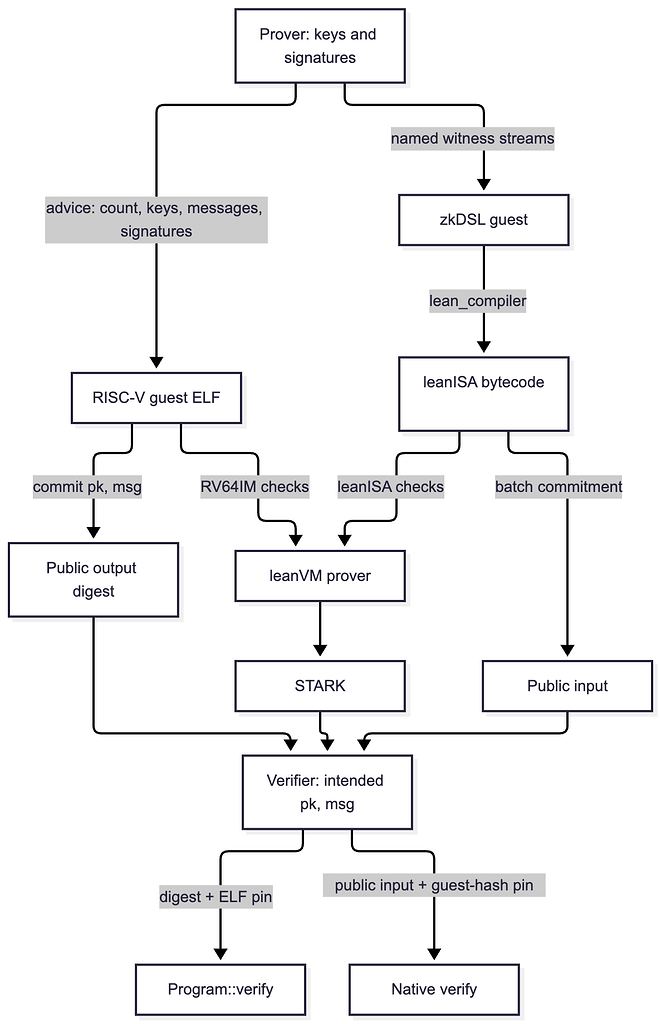
At 23:33 on 2026-11-16. manel1874 of MultiVM Labs proved verification of five schemes under leanVM (Falcon-512, ML-DSA-44, FORS, Raccoon-128 and Raccoon-G) on an Apple M4 Pro with 24 GiB. The first four fit in a single leanSTARK; Raccoon-G needs about 839 million witness words against a 268 million cap, so it was split into five proofs and aggregated recursively. In single-signature runs only Falcon-512 and FORS peaked below 4 GiB of memory, which makes them the plausible browser candidates. The post sketches a flow where the wallet signs locally and an untrusted external aggregator produces the proof, and notes that LEANSTARK_SCHEME is still reserved in the 8288 draft and MAX_LEANSTARK_DEPS_PER_WRAPPER=1 would need revisiting. The author also cited these numbers in the EIP-8288 discussion thread at 23:42.
Ethresear.ch: benchmarking post-quantum signature aggregation for EIP-8288 at 23:33 on 2026-11-16. manel1874 of MultiVM Labs proved verification of five schemes under leanVM (Falcon-512, ML-DSA-44, FORS, Raccoon-128 and Raccoon-G) on an Apple M4 Pro with 24 GiB. The first four fit in a single leanSTARK; Raccoon-G needs about 839 million witness words against a 268 million cap, so it was split into five proofs and aggregated recursively. In single-signature runs only Falcon-512 and FORS peaked below 4 GiB of memory, which makes them the plausible browser candidates. The post sketches a flow where the wallet signs locally and an untrusted external aggregator produces the proof, and notes that LEANSTARK_SCHEME is still reserved in the 8288 draft and MAX_LEANSTARK_DEPS_PER_WRAPPER=1 would need revisiting. The author also cited these numbers in the EIP-8288 discussion thread at 23:42.
Meets today, 2026-11-17, at 21:00. The agenda covers an L1 R&D and Devcon recap, future compatibility with EIP-8288 and leanPCS, devnet status and spec changes, and a call for feedback from wallets, tooling and app developers.
At 17:09 on 2026-11-16, adding public mempool rules. EIP-8151 makes ecRecover return a result only for accounts with no code or an EIP-7702 delegation, so an EIP-8141 validation prefix that calls it depends on a third party's code. The new rules record each recovered address and its code class as a signer dependency (except tx.sender) and revalidate when the class changes. They cap pending transactions per recovered address in two shares: recoveries over this transaction's signature hash, TXPARAM(0x08), use a reserved share, while other digests get a smaller one, because anyone can replay an old signature. Paymaster recoveries count once per paymaster.
Opened at 17:51 on 2026-11-16, adds pointers to the 8151 rules in 8141's policy summary, direct evaluation and revalidation sections.
Opened by nerolation at 14:00 on 2026-11-16: a SPHINCS account puts its signature in an ARBITRARY entry with an empty msg, and its VERIFY frame reads it with SIGDATACOPY, checks it against the signature hash and its public key, and approves. No new signature scheme is needed.
At 00:53 on 2026-11-17. johba posted receipt data from a frame account with hash-based keys on Daisugi, which runs Nethermind's EIP-8141 prototype (signatures verified in the EVM, no aggregation):
At 04:56: the permission belongs in the leaf predicate but has to be checked in VERIFY. He suggests one bit in the slot word that, when set, makes validation refuse any sender frame targeting the account itself, for roughly 2k extra gas.
20:26 to 20:28 on 2026-11-16. Author johba addressed two points. A signature count is state and a phrase restores none, so for key types whose limit could realistically be reached, the phrase-derived key should only certify other keys and each device should sign with its own. And when a restore finds no key in use, the wallet should say which key types it tried and that another wallet might find keys it didn't.
At 00:58 on 2026-11-17. Zealynx added that owners and threshold aren't the whole picture: an enabled module can call execTransactionFromModule with no signatures, and from 1.3.0 a guard can veto anything the owners sign, so every chain also needs reads of getModulesPaginated and the guard slot.
Reported by The Block on 2026-11-16: names, phone numbers, addresses, emails and purchase details for about 27,000 orders placed from 2026-08-09 to 11-07 were exported. Trezor's systems and wallet backups weren't affected, but some customers have already had scam calls. If you ordered in that window, treat any order-related contact as suspicious and never share your recovery phrase.
Data breach at Trezor shipping partner Skladon, reported by The Block on 2026-11-16: names, phone numbers, addresses, emails and purchase details for about 27,000 orders placed from 2026-08-09 to 11-07 were exported. Trezor's systems and wallet backups weren't affected, but some customers have already had scam calls. If you ordered in that window, treat any order-related contact as suspicious and never share your recovery phrase.
On 2026-11-16. The judge found prosecutors hadn't shown any material misrepresentation in the 2023 MEV-Boost exploit worth about $25 million, so the wire fraud and related charges failed.
At 21:53 on 2026-11-16. Both sit in Others because their deployed fault proofs don't work, and the same Conduit 4-of-11 multisig can upgrade core contracts with no delay and no exit window. If you use these chains, know that withdrawals depend on whitelisted proposers.
At 00:01 on 2026-11-17: even with encrypted amounts, a public deposit caps what you can send, and combining those caps across transactions can sometimes reveal the hidden amounts. When using privacy protocols, avoid linking amounts and timing.
At 22:16 on 2026-11-16: 1,219 active apps for 11-09 to 11-15, with 517 cross-chain, 345 on Ethereum L1, 117 on Base, 66 on Arbitrum and 25 on Starknet.
Meets at 23:00 on 11-18. In a comment at 07:03 on 2026-11-17, abcoathup argues for AI review of PRs, automatic number assignment and auto-merging once checks pass.
EIPIP #132 meets at 23:00 on 11-18. In a comment at 07:03 on 2026-11-17, abcoathup argues for AI review of PRs, automatic number assignment and auto-merging once checks pass.
Is today at 20:00; ACDT #104 is at 21:00 on 11-23, with the CL part carrying over consensus-specs #5770 and #5820.
FOCIL Breakout #46 is today at 20:00; ACDT #104 is at 21:00 on 11-23, with the CL part carrying over consensus-specs #5770 and #5820.
At 00:24 on 2026-11-17: a batch of docs, fixes and eth_simulate PRs is set to merge.
04:36 to 06:54 on 2026-11-17: the author demoed an NFT card in Apple or Google Wallet that lets you vote with a tap from the lock screen, and fixed four issues a reviewer reproduced (npm 0.5.1).
At 13:50 on 2026-11-16: Frames give the execution layer cryptographic agility, and privileging one signature scheme early doesn't exclude others. The consensus layer has less agility built in, and the main question there is performance, for example whether DVT support is required, which doubles signature sizes.
At 22:05 on 2026-11-16.
At 23:57 on 2026-11-16: "Rushing into PQ for memetic reasons seems like a bad idea."
At 23:13 on 2026-11-16: the core question is how Ethereum can evolve without unexpectedly breaking existing apps while giving developers and enterprises enough information and time to prepare.
At 02:59 on 2026-11-17: abcoathup notes Hegotá's scope may change for pqai, possibly delaying FOCIL or even splitting the upgrade into separate execution and consensus layer upgrades.
At 01:33 on 2026-11-17, the first in a post-quantum series on how ethrex and ethlambda can help Ethereum be post-quantum ready by 2028.